


From web developer to entrepreneur: The print-on-demand way
February 27, 2026 | by deven.khatri@gmail.com

Making the leap from 9-to-5 to full-time seller
Before going all in on entrepreneurship, Ryan managed to juggle several income streams at once.
“I’d be at work building websites for nonprofits, and with my spare time, I spent as much as possible building my print-on-demand business on the side and my FBA business.”
Even as his side hustles grew, he remained cautious about leaving a steady paycheck too soon. “I usually tell people to hold on to your day job as long as you can, as long as it makes sense,” he explained.
Ryan felt that uncertainty firsthand. “For me, the first day was by far the scariest,” he said. “The back end of it is the finance side – understanding expenses, projected income, and whether I can cover my costs.”
However, by 2019, those ventures were outpacing his full-time income. But Ryan waited until 2020 to officially take the leap. Ironically, he left just a month before the pandemic hit, but never looked back. “I was happy to really embrace learning print on demand,” he said.
Why patience and steady growth paid off
Ryan’s journey was built slowly, through trial and consistency. He often reminds new sellers that sustainable growth matters more than overnight results.
“People see me now and think it was overnight,” he said. “But it really was a very slow grind, and I was very methodical. I didn’t try to push it too hard initially.”
For the first two years, he handled everything manually. That hands-on approach helped him understand how print-on-demand worked from the ground up. “I faced the learning curve and took it slow,” he noted.
Over time, as he learned and refined his process, the effort began to pay off. “It’s a completely different business today than it was back then,” Ryan said. “I was happy to embrace the slow phase.”
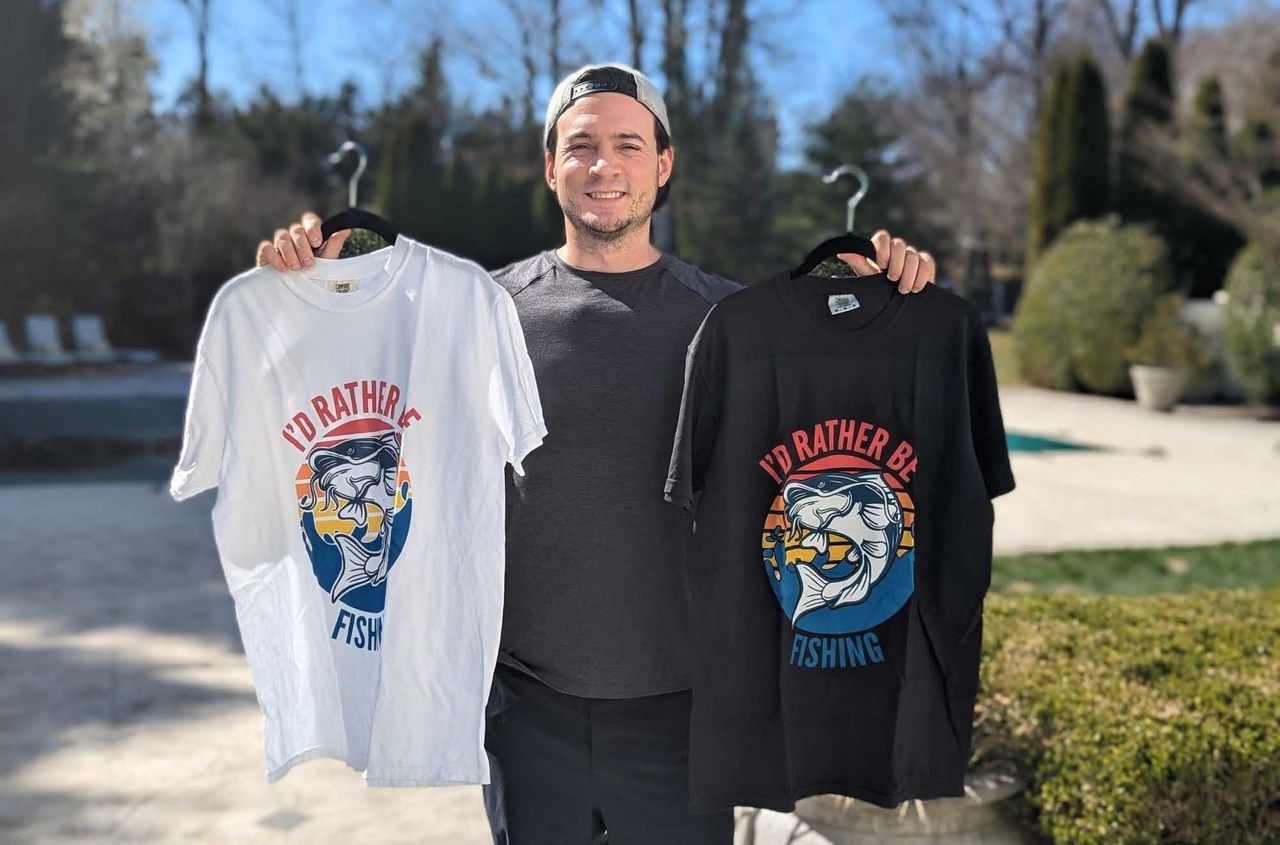
Research is at the core of Ryan’s approach to print-on-demand. He relies heavily on data, trends, and simple tools to decide what to create next.
“I love a good research tool,” he said. “Amazon is especially my favorite because they make publicly available two data points that are extremely valuable. The date a listing was published and its Best Seller Rank.”
Those two metrics help him identify early signals before a trend becomes saturated. “If a listing was uploaded yesterday and already has a BSR, that means it sold,” Ryan explained. “That could be a sign of a coming trend.”
He also emphasizes the importance of due diligence – checking trademarks and avoiding copyrighted material before launching any product. Beyond research tools, he uses accessible design software like Kittl or Canva for quick creation, while occasionally turning to Adobe Photoshop or Illustrator.
Scaling a print-on-demand business with Printful product templates
Managing thousands of listings across multiple marketplaces required a system that could save time without sacrificing quality. Printful’s product templates proved to be one of the tools that made this possible.
“I love talking about Printful templates,” he said. “You can open an account for free, integrate it with your eCommerce platforms, and create products rapidly.”
Using templates, Ryan can upload a single design and apply it to several products at once (like a t-shirt, hoodie, tote bag, or mug) with just a few clicks. Each product starts with a selection from the Printful Product Catalog, which he says makes setup simple. “You can create up to five products at a time,” he explained. “Then you can title each product once and publish it to your store directly.”
This process helped him scale faster while keeping operations simple. “Printful has accomplished something I really appreciate as a former web developer,” Ryan said. “They built a user-friendly interface that lets you do everything in as little time as possible.”
Expanding reach through multi-marketplace selling
“I have a mantra,” Ryan said. “Occupy as much online real estate as possible. In real life, real estate is expensive, but online real estate is cheap.”
That mindset led him to list his products across Amazon, Etsy, eBay, and even Walmart when the integration was available. “If somebody finds a trending t-shirt on Amazon, I also want that same shirt available on Etsy and eBay,” Ryan explained.
Thanks to Printful’s integrations, he managed all these stores from Printful’s Order tab. His products now reach customers across multiple marketplaces without multiplying the workload.
Beyond sales, the multi-marketplace presence helped his SEO (search engine optimization) rankings. “All of my product listings on Walmart were getting indexed on Google,” he said. “Same with my eBay, Etsy, and Amazon listings.” The more listings he published, the more touchpoints he created for customers searching online.

Simplifying design strategy for consistent sales
Ryan’s design process is intentionally simple. He doesn’t chase elaborate artwork or trends. Despite his technical background, design wasn’t his strength, but he learned that simplicity often wins.
“Over half of my designs that sell in a year are text-based.” When creating new products, he often makes two versions: one with text only and another with text plus a graphic.
For Ryan, the key is the outcome. “It doesn’t really matter how you get to your end goal,” he explained. “You could design it yourself, license graphics, or use AI. What matters is that your customer finds what they’re looking for.”
Freedom is the real measure of success
After years of being tied to office schedules and client deadlines, he finally built a business that allowed him to work on his own terms.
“When I was working my 9-to-5 job, I felt guilty leaving,” he said. “Even taking a day off gave me anxiety.”
Print-on-demand changed that balance completely. It gave him flexibility and space to live without constant stress over time or income. He now has the freedom to travel and take amazing trips with his wife.
He still earns from the products he listed years ago. “They get automatically fulfilled by Printful, and I still get a little bit of profit,” he recalled.
Recovering from setbacks and protecting progress
Like many online sellers, Ryan’s path wasn’t without setbacks. His biggest challenge came in 2019, a blow that cost him thousands of listings and years of progress.
“My Etsy account was closed, not because I really did anything wrong,” he noted. “I probably uploaded one or two listings that I shouldn’t have, like a little play on a popular logo, but nothing serious.”
He noticed competitors exploiting reporting systems to take down rival listings. “It was completely automated. You could just fill out the form, and they’d remove your listings,” Ryan explained.
But he didn’t dwell on the loss and focused on rebuilding. He later returned to Etsy. The platform today doesn’t operate the same way as it used to. But the experience is a reminder not to rely on one platform.

Advice for new sellers starting today
“If I were doing it today, I’d have no problem hiring a coach who’s already achieving the success I want,” he said. He credits much of his early progress in Amazon FBA to having a mentor who helped him avoid costly mistakes. “With my Amazon FBA business, I had to hire a coach. I couldn’t figure out all the moving pieces on my own.”
Ryan often says that getting started is the hardest part, not because the process is complex, but because people tend to overthink it.
He also says it’s almost impossible to go wrong with a print-on-demand business because it’s all laid out for you. All you need to do is just price correctly so you don’t lose money, and adjust as you go.
He stresses time as the most valuable resource. “For me, the core equation of business is ‘time is money, ’” Ryan recalled. “There are good strategies out there, but some just take too much time relative to what you get out of them.”
Redefining success and paying it forward
Ryan’s story comes full circle, from a developer tied to his desk to an entrepreneur who built a business that runs on his terms. What began as a side project in 2017 has become both a source of steady income and proof that freedom can be designed through persistence, not luck.
He now shares what he’s learned through his YouTube channel and online resources, helping others build sustainable print-on-demand businesses of their own. “If I can serve as inspiration, I just hope I can show people that it can be done.”
Ryan is right, hitting “publish” for the first time is the most challenging part. But once the first product is out there, progress builds naturally. Start your own print-on-demand story with Printful. It’s free to try, and who knows, it could be your next career.
RELATED POSTS
View all


How to print on metal: 3 Methods with beautiful results
July 29, 2025 | by deven.khatri@gmail.com

5 Different Types of Men’s T-shirts & How to Style Them
May 17, 2025 | by deven.khatri@gmail.com
Leading strategies for selling apparel on eBay in 2026
January 16, 2026 | by deven.khatri@gmail.com