


How to sell print-on-demand products on Amazon
January 3, 2026 | by deven.khatri@gmail.com

Here’s how to sell Print on Demand on Amazon in a nutshell: create an Amazon Professional seller account, connect a print-on-demand service, design the products you want to offer, and list them in your store. From there, you can start selling and scale your Amazon POD business with smart marketing and ongoing optimization.
We’ll cover everything from account setup and product design to Amazon integration and listing optimization so you can confidently start your print-on-demand business.
1. Create an Amazon seller account
Before you can start your POD business on the Amazon marketplace, you’ll need a seller account. It’s where you’ll manage listings, track orders, and review the performance of your Amazon store.
Step 1: Choose the Professional plan
Amazon has two main seller accounts – Individual and Professional. To sell print-on-demand products, you’ll need to upgrade to the latter.
At $39.99/month, the Professional plan gives you access to the Amazon Selling Partner API (SP-API). This is what lets your POD supplier automatically receive and fulfill your orders. You’ll also unlock tools like bulk listing, analytics, and eligibility for Amazon Ads.
Step 2: Sign up for your Amazon seller account
Submit your business details and upload verification documents. Here’s what the process looks like:
-
Visit Amazon Seller Central and click Sign Up.
-
Enter your business and legal identity information (name, address, and entity type).
-
Add bank account details that match your business name or personal name.
-
Provide a valid credit card for subscription fees.
-
Upload a clear copy of your government-issued ID and a recent Proof of Address (such as a utility bill or bank statement dated within the past 180 days).
The whole process for approval can take anywhere from a few hours to a week. Once you’re in, you can start preparing your Amazon store for your first print-on-demand products.
2. Choose your print-on-demand supplier
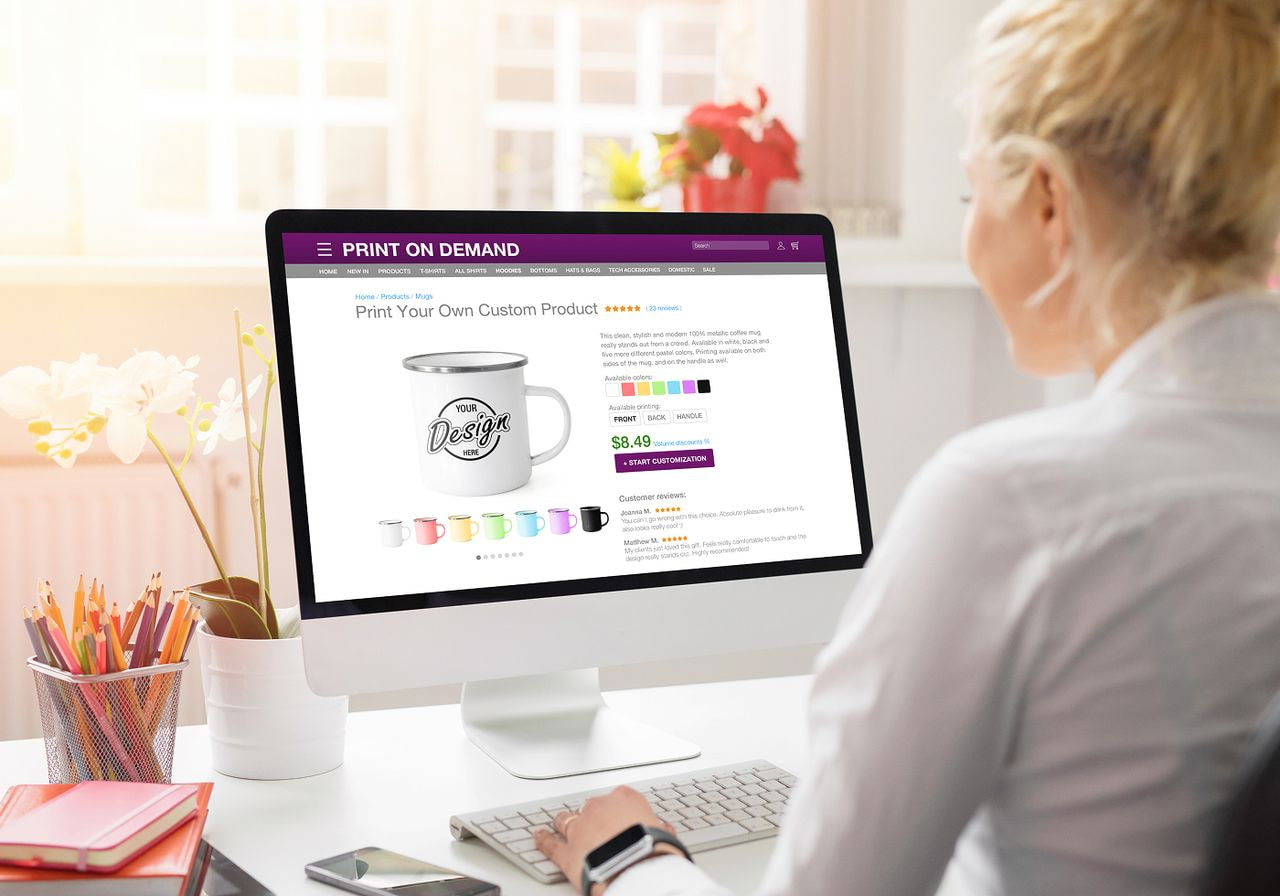
Selling Print on Demand on Amazon becomes easier once you choose the right POD supplier.
Two of the most common POD options for Amazon sellers are Printful and Amazon Merch on Demand. Both work well, but they serve different types of sellers.
Printful
Printful is an all-in-one POD platform with Amazon integration that lets you connect your seller account in just a few steps. Once connected, Printful prints, packs, and ships your orders automatically.
It’s also suitable as an alternative to Amazon dropshipping, since you don’t carry inventory and everything is fulfilled on demand.
Best for: Sellers who want full creative control, strong branding options, and a large product catalog.
Pros:
-
High product quality. Printful uses top-quality materials and printing methods. Our Catalog has 461 products across apparel, accessories, home decor, and more.
-
Beginner-friendly tools. Our free Design Maker helps turn your ideas into reusable product templates – no design skills needed.
-
You control your brand. We print and ship everything under your brand with optional custom labels, pack-ins, and other branding options.
-
Low shipping rates. With multiple fulfillment centers and global carriers, shipping stays affordable and reliable.
Cons:
-
Higher per-unit costs. POD items cost more than bulk inventory, which can reduce margins.
-
Longer production time. Print on Demand requires 2-5 business days to print orders before shipping.
Amazon Merch on Demand
Amazon Merch on Demand is Amazon’s built-in POD program. It operates similarly to Printful – Amazon handles production, inventory, shipping, and customer support. You simply upload your designs, list your products, and get paid when orders come in.
Best for: Sellers who want an automated, hands-off Amazon POD experience.
Pros:
-
Fully automated fulfillment. Printing, shipping, returns, and support are handled by Amazon.
-
Prime eligibility. Merch products are eligible for Prime Shipping, giving your online business a competitive edge with quick delivery.
-
Fast setup. You can use an existing Amazon account to streamline the sign-up process, and there’s no need to connect a third-party POD platform.
Cons:
-
Limited branding. You can’t customize packaging or create a standalone brand experience.
-
Tier restrictions. Sellers start with a limit of 10 new designs and must make sales to unlock higher tiers.
3. Create and list your products

Once your Amazon account and POD supplier are set up, create your products and add them to your Amazon store.
Step 1. Design your products
Your design is what makes your product stand out, so keep it focused and geared toward the audience you want to attract. Think about who you’re designing for and what message or feeling the product should communicate.
Here’s the good news – you don’t need graphic design skills to create unique products. Printful sellers can use the Design Maker, which includes free graphics, text tools, clipart, and built-in product mockups.
If you prefer external tools, any apps that can export high-resolution images will work. Check out our top picks for t-shirt design software.
A few simple tips to keep your designs sharp:
-
Quality. Use clean, high-resolution images and graphics that won’t blur when printed.
-
Readability. Choose fonts that are easy to read at different sizes.
-
Uniformity. Stick to a consistent color palette for a cohesive look.
Use mockups or lifestyle shots so customers can clearly see what they’re buying. Keeping your designs clear and polished makes your Amazon store look more trustworthy, leading to more clicks and conversions.
Step 2. Choose products to sell
The easiest way to narrow down your options is to focus on products your audience already buys often. If you’re looking for ideas, here are the most profitable POD products according to our research.
Custom t-shirts
Custom t-shirts are one of the easiest and most reliable products to sell with POD. They work for almost any niche, offer endless room for creativity, and have steady, year-round demand.
Whether your audience prefers funny quotes, niche artwork, or minimalism, you can create t-shirt designs that match their style.
They’re also affordable to produce, which helps keep your profit margins healthy. Budget-friendly shirts like Gildan are great for everyday use or bulk orders, while premium brands like Bella + Canvas attract potential customers who prioritize softness and comfort.
Custom hoodies
Custom hoodies take comfort and personal style to the next level. The thicker material and added features – like a hood, pocket, and drawstrings – mean customers are more willing to pay a higher price. This gives you better profit potential compared to t-shirts.
This apparel product is especially popular in niches like streetwear, fitness, gaming, and campus wear. You can experiment with large back prints, front graphics, sleeve details, or embroidery, depending on the style you want to create.
Since hoodies are used year-round but peak in colder months, they’re great for both evergreen and seasonal collections.
Baby and kids’ clothing
Baby and kids’ apparel is always in demand because new parents, relatives, and gift shoppers buy these items year-round. Sizes turn over quickly as kids grow, which helps attract repeat purchases.
You can offer a wide range of products – bodysuits, toddler tees, hoodies, and more – and personalize them with cute graphics, names, milestones, or character-style designs. These products sell especially well for birthdays, baby showers, holidays, and back-to-school seasons.
Phone cases
Custom phone cases are a strong choice if you want a lightweight, high-demand product with broad appeal. With billions of smartphone users worldwide, people are always looking for ways to protect and personalize their devices. This means phone cases get steady traffic and make great impulse-buy items.
They’re also extremely versatile. You can create cases based on trending aesthetics, memes, niche hobbies, or seasonal themes. Offering different case types – such as tough cases, MagSafe-friendly cases, or clear cases – helps you reach more buyers and match different price ranges.
Personalized notebooks
Custom notebooks are simple yet surprisingly profitable among customers who love writing, journaling, and planning by hand. They’re also highly giftable, making them strong sellers for birthdays, holidays, and back-to-school seasons.
Customize the covers with themed artwork, names, quotes, or brand-specific designs to make them appealing for your niche. Whether your audience wants to jot down ideas or sketch, notebooks are a universal everyday item that keeps sales steady.
Mugs
Mugs are practical, gift-friendly, and easy to customize. People buy them for home, office, birthdays, holidays, and corporate gifts – and they stay in constant demand.
They’re inexpensive to produce and ship, helping to boost your margin. Plus, customization options are endless – quotes, pet portraits, aesthetic designs, and themed collections all sell well.
You can also offer different mug styles like coffee mugs, travel mugs, or metallic finishes to stand out.
Not sure where to start?
Browse Amazon Best Sellers, New Releases, and Movers and Shakers for ideas. Look at what’s trending, read reviews, and note which listing styles seem to convert well.
As you narrow down your choices, consider what your niche is likely to buy, how competitive the category is, production and shipping times, and profit margins.
Once you’ve chosen the products, you can publish them through your Amazon Seller app or upload them directly to Amazon Seller Central. If you’re using Printful, product publishing is even simpler. Designs, product details, and mockups sync directly to Amazon, speeding up your launch process.
RELATED POSTS
View all

Shop Men’s Linen, Floral & Stripe Shirts Collection Online at Vestirio – VESTIRIO
September 21, 2025 | by deven.khatri@gmail.com

What is Polyester? Uses, Benefits & Drawbacks
July 19, 2025 | by deven.khatri@gmail.com

Chic And Cozy Winter Outfit Ideas For Women 2025
November 25, 2025 | by deven.khatri@gmail.com